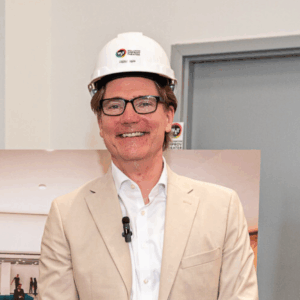
Meet the improviser who’s designing WIT’s new home in NoMa
Matt Alexander — whom WIT community members will recognize from his performances in last summer’s production of Table Talk: An Improvised Tale of Adventure and as part of the Harold program — is the man behind the exciting designs for WIT’s one-of-a-kind learning, training, and performance space in Northeast DC, which is slated to open in January 2027.
Matt’s architectural firm DMArchitects, of which he is Principal and Founder, has a reputation for creating innovative spaces that strengthen and empower communities.
Their approach, which seeks to “create environments that inspire connection, service, and shared purpose” — combined with Matt’s professional expertise and personal experience as an improviser — led WIT’s board to entrust DMArchitects with designing the new site, which is located at 1222 3rd St. NE. It’s just steps from the NoMa-Gallaudet Metro station and a stone’s throw from Union Market.
WIT’s Anna K. Nelson asked Matt about the designs, his philosophy on creating spaces that serve communities, and what excites him most about WIT’s new home.
WIT: Let’s talk first about where things are at with the project overall. Are hammers already swinging?
Matt: Hammers are not swinging yet… but it won’t be too long! One benefit of building out an existing space like this is that the building shell and infrastructure are already in place, making the overall design and construction duration a lot shorter than if we were building the theater from the ground up.
As far as what is happening right now: we are at the last part of the design phase, wrapping up the construction documents (often referred to as ‘blue prints,’ even though actual blue prints have not been printed in at least 55 years!) By early February, we will move into the bidding and permitting phase of the project, when the drawings will be reviewed for approval by the DC Department of Buildings, while simultaneously being issued to contractors.
The timeframe for that phase can be difficult to predict as review times can vary, but we expect it to be complete and for hammers to start swinging some time in late spring or early summer of this year. Construction is currently anticipated to take until January 2027.
WIT: Would you walk us through the main elements of the new venue? What will be on the ground floor versus the lower level?
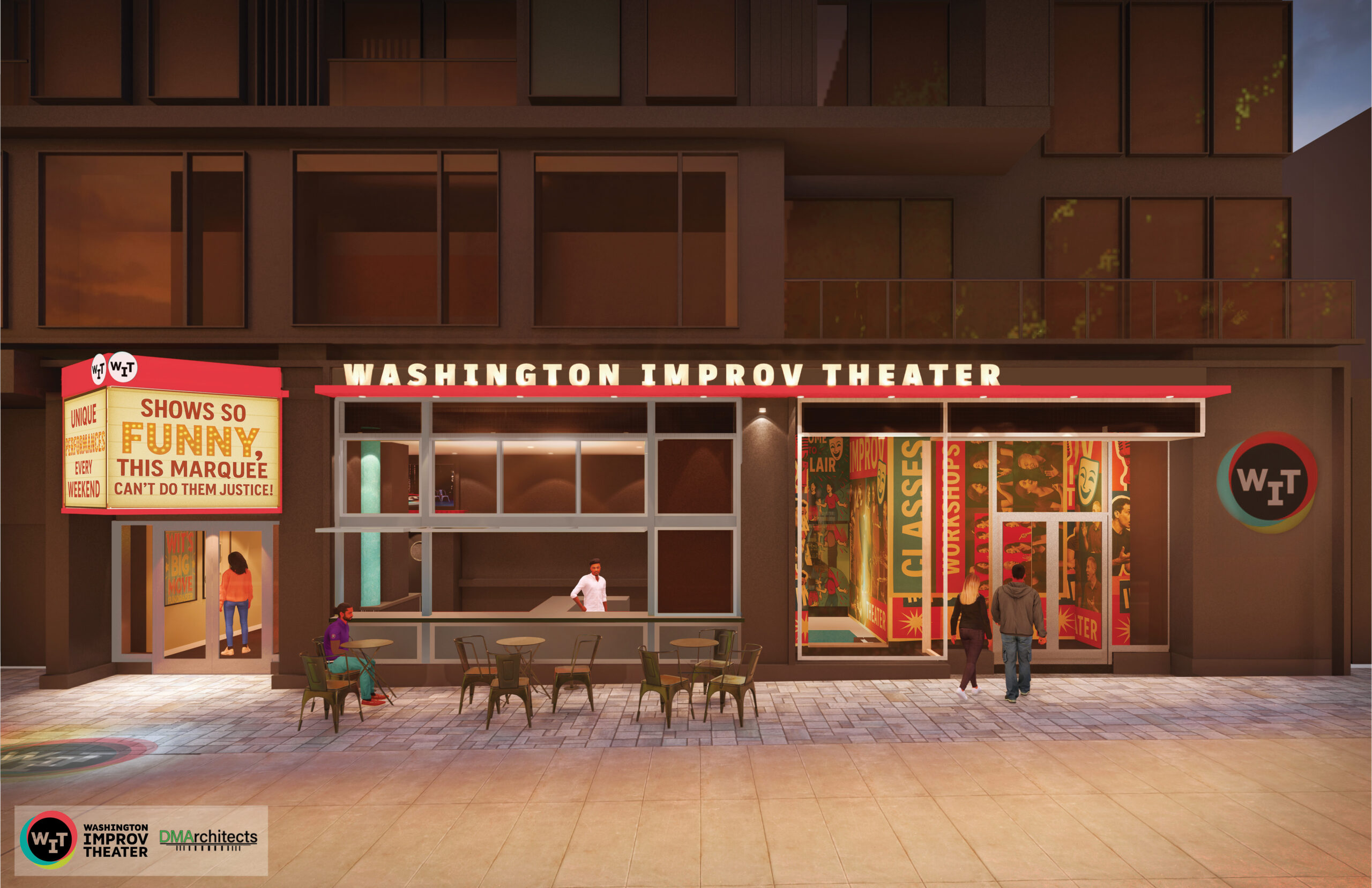
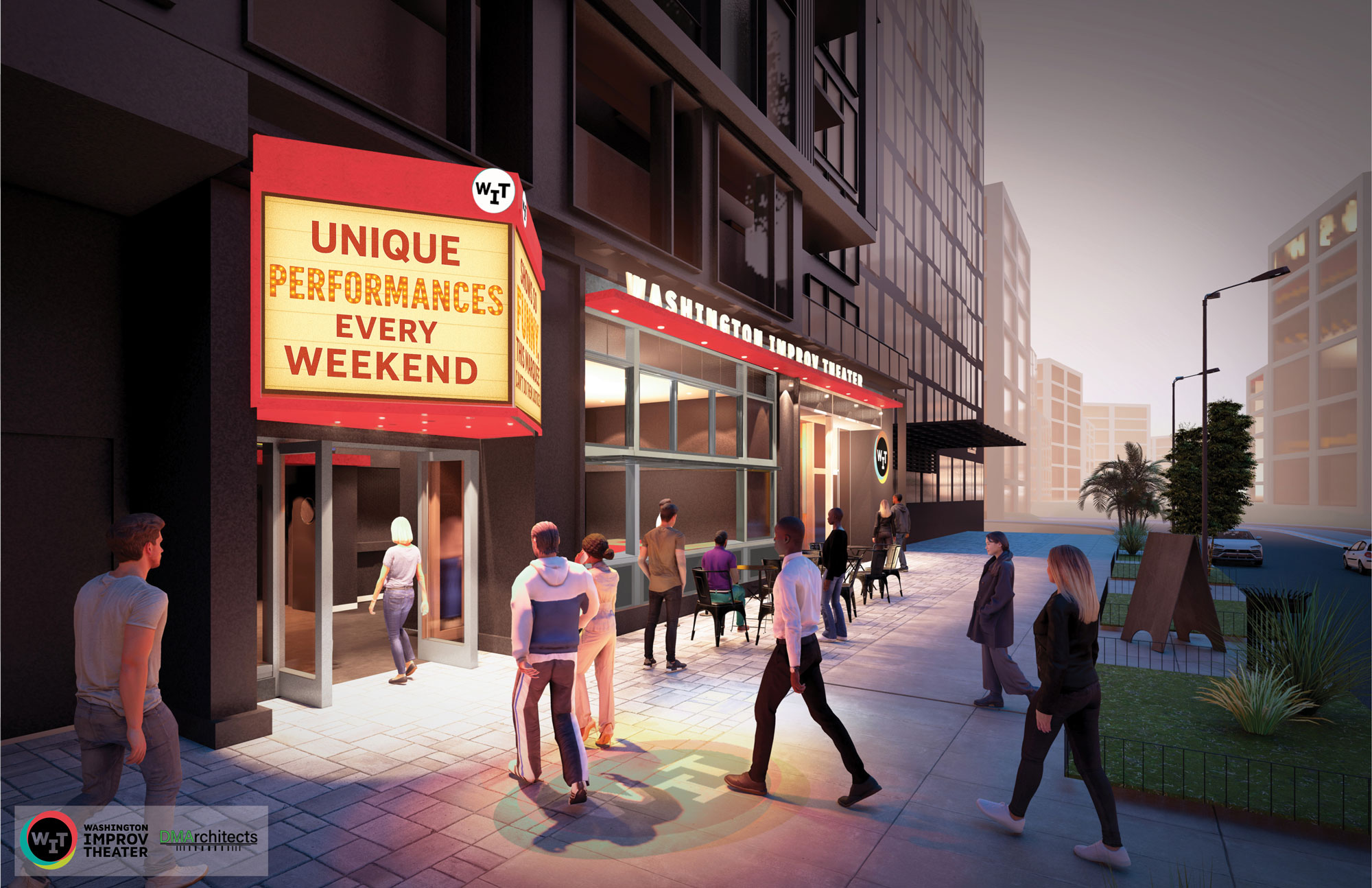
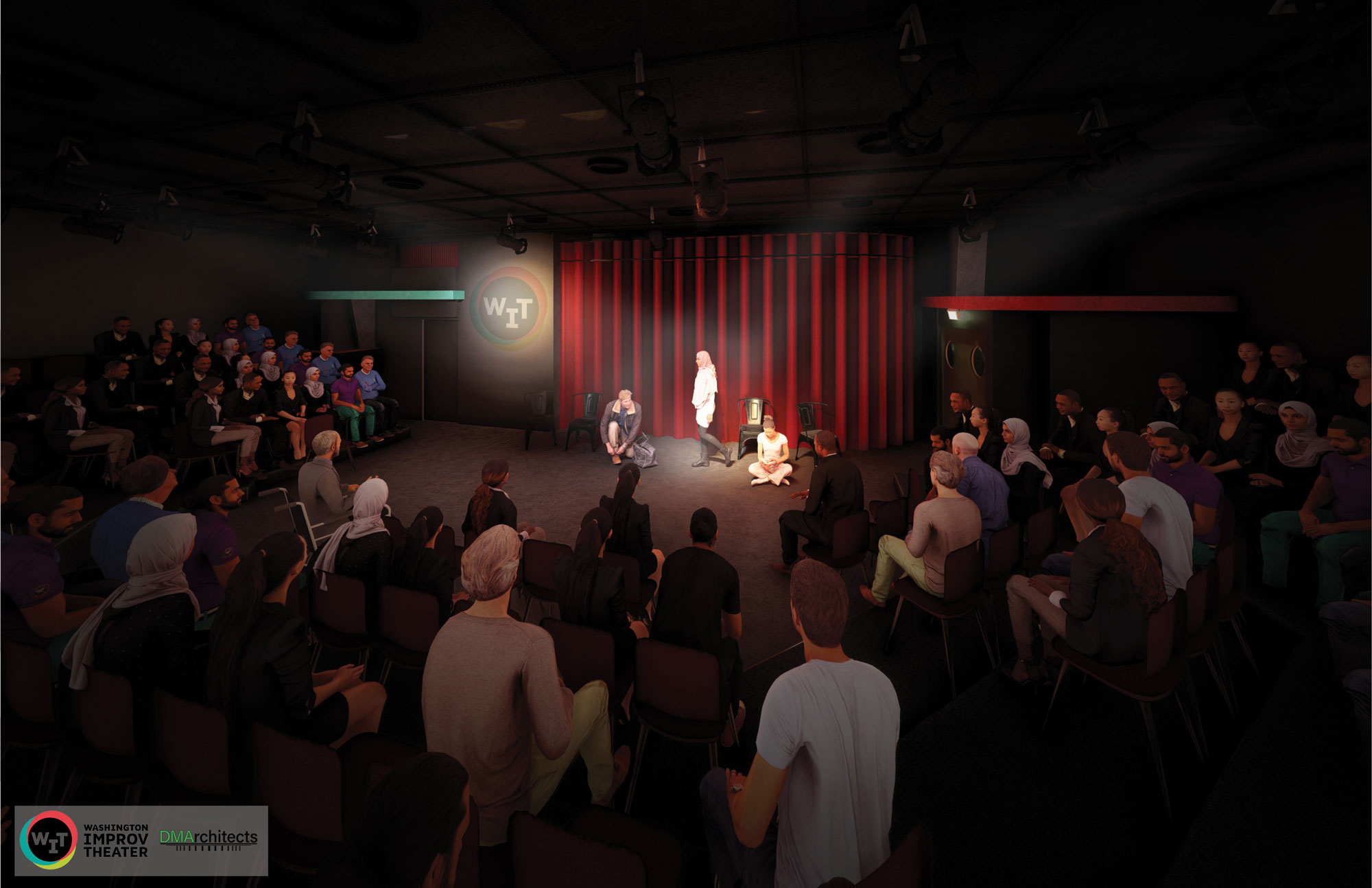
Matt: So, the new venue will have all of WIT’s programming under one roof! There are two main entrances accessed from the street level — one leading to the theater (under a digital marquee) and one leading downstairs to the classrooms. The theater has a capacity of 110 people with flexible chair seating on moveable risers. Importantly, all seats will have a clear view of the stage. The bar/cafe will have operable windows that will open the space out to the sidewalk seating area. If you’re familiar with Pearl Dive on 14th St. NW, it will be like that.
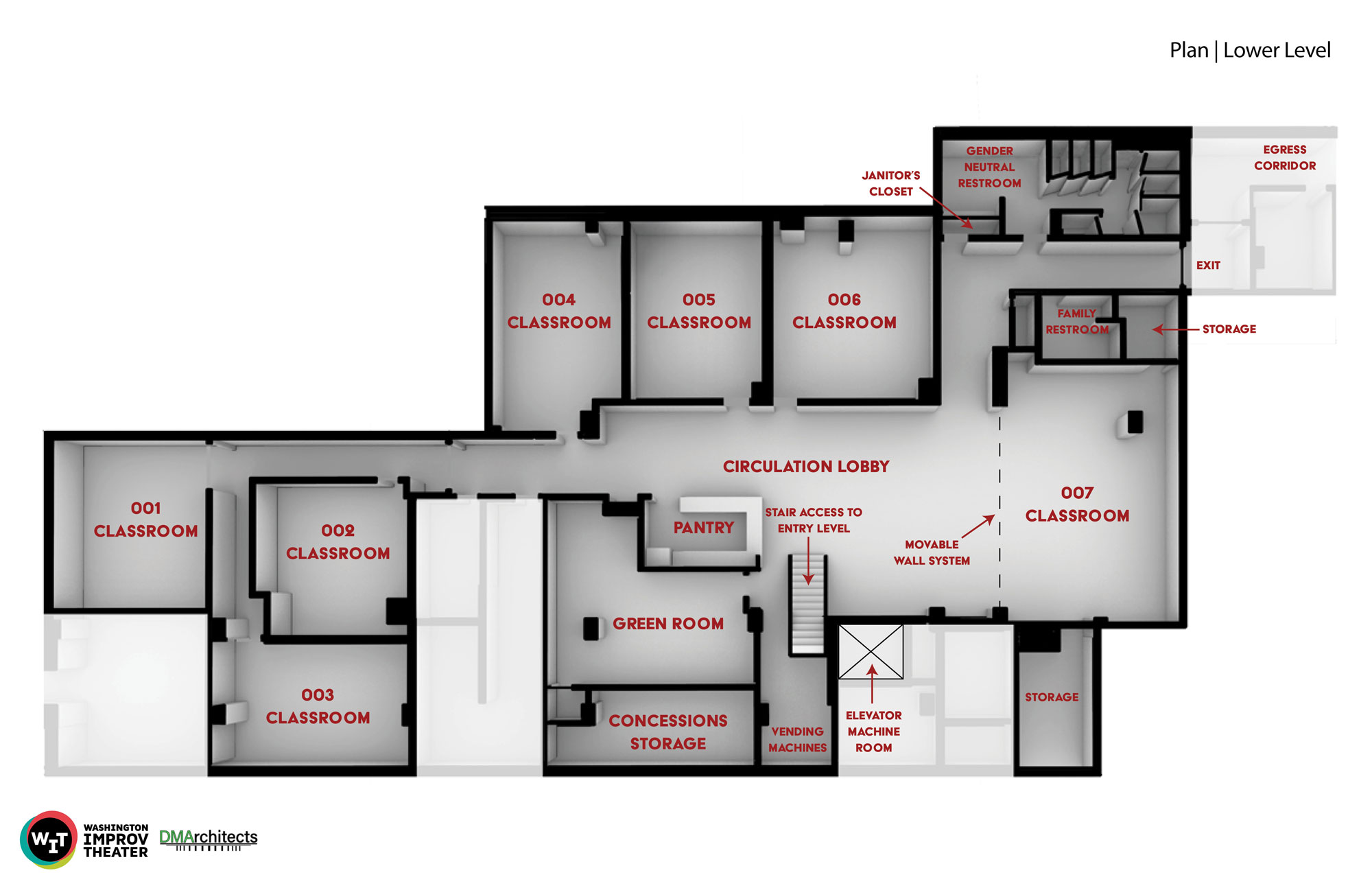
The lower level will have seven classroom/rehearsal spaces, a green room, pantry, and central lounge area. The configuration of this lower level lounge is designed to encourage and support a sense of community and give people places to hang out before, between, and after class or practice. The lower level is also flexible enough to enable WIT@Work to hold training workshops there. Two of the classrooms will have the capacity to be merged into one, larger space and we will have lighting and rigging in classroom number 7 that will enable it to function as a small performance space of its own.
A big design challenge for us was to figure out how to celebrate the multi-faceted ways in which WIT serves the community as a theater, improv school, and training center, while providing a “unified feel” for the organization, especially as one approaches the exterior. In particular, we wanted to give each entrance its own character so that it’s clear where to go depending on if you’re there to see a show or take a class. That’s where we leaned into and celebrated WIT’s long-established brand of using red to signify shows, green for classes, and teal for WIT@Work.
The illuminated letters across the top of the facade that spell out “Washington Improv Theater” will sit on a red ledge and the digital marquee, which WIT will be able to change as often as it likes to promote, for example, which ensembles or indie troupes are playing on any given night or welcome a group arriving for a WIT@Work training, will be framed by WIT’s signature red. The WIT logo that features interlocking red, green, and teal semi-spheres that form a circle around the acronym will also be on display out front next to the entrance that leads to the classrooms downstairs.
WIT: In the process of finding a suitable location, you and WIT’s Artistic and Executive Director Mark Chalfant went on more than 25 site visits around DC together. What was it about 3rd St. NE that stood out to you from an architectural standpoint?
Matt: Oh my, this could be a whole story to itself! Well, when we started the search we had a short list of criteria that a new space had to have. Accessibility, location near a metro, safety, the kind of night life (if any) around the site, cost, etc. On top of that, you have the physical constraints, such as the height of the ceilings, space between support columns, etc.
We looked at old churches for sale, a shop that repaired dry cleaning equipment, several office spaces, a former museum, and even an old testing center. The 3rd Street NE location was in a group of about 10 that we looked at with WIT’s broker, Transwestern, and it was initially appealing because the building was newer (which meant it most likely would already meet accessibility requirements such as having an elevator). And, it was in a part of the city (NoMa), which is really growing. After the first visit, we came up with a matrix and 3rd Street NE checked all of those boxes. We did some test fits and confirmed that WIT could get all of the space we needed under one roof.
The more we went back, the more we realized what a great opportunity this could be. And, importantly, the landlord was extremely enthusiastic and really wanted WIT there.
The space turned out to be a great location in a newly-built and accessible building with street front access and high ceilings that are great for a theater, plus a landlord who could see the potential of becoming home to an improv theater. The NoMa Business Improvement District was also looking for a “Cultural Anchor” for the neighborhood and WIT fits the bill!
WIT: You care deeply about creating spaces that put people/the community at the center. Can you say more about that?
Matt: Yes, that is really the driver of my practice. I love to help people, and, in particular, enhance an experience for people and be part of the process of giving them a place to call their own. That can take many forms — places of worship, community centers, non-profit organizations, and of course improv! I love to learn more about my clients and the people that may use a space that I work on, and what is important to them. As an example, WIT provides a space for people to experience joy, make friends, and feel they are part of something. Improv is such a wonderful activity, and designing a permanent home for that mission is as good as it gets for me.

WIT: How has your knowledge and experience as an improviser, and as a previous WIT student, informed and influenced the designs?
Matt: It has had a huge impact! I completed all of the WIT improv levels, as well as a bunch of workshops and the Harold program and spent many a night in a classroom somewhere in the city that doubled as something else — a preschool, church basement, or office space. I loved all of it, but sometimes, the space would be a bit cramped or the furniture would have to be moved out of the way and put back just so. Other times, you could hear the class next door or you’d arrive late and have to wait for someone to come open the door. Those are things we’re addressing to make the classroom experience so much better.
Having the opportunity to design a venue with improvisers in mind is a dream. Developing the performance space is awesome, and that certainly has been a huge part of the design process and interest of mine, but for most people, their first and primary experience with WIT is in the classroom. So we’ve put a lot of thought into how we can make that a great experience… from thermal comfort (HVAC systems) and the acoustics, to coloring, lighting, and finishes… all of these things come into play. I’ve imagined myself as a Level 1 student, who just signed up for their first improv class not really knowing what they got themself into, and how that experience will feel, arriving at the new space. Walking up to the building, entering to go downstairs, and finding an inviting space to spend a few hours. There are other little things, like being able to imagine what it will be like to warm up in the green room, then come up the stairs, walk backstage, say “Got your back,” to my teammates, and walk out on stage. I feel like being an improviser has allowed Mark and I to have a shorthand when talking about things during the design process.
WIT: What are the unique concerns or challenges that come with designing an improv theater versus a traditional one?
Matt: I think that as theaters and performance spaces go, improv theaters have a lot less ‘stuff,’ like sets, costumes, and other equipment. But there are still challenges with acoustics, for example, since most improv is performed without microphones so you have to take that into account. Most improv venues tend to be smaller, which means you are typically trying to design a seating area in a space that may have a lot of columns or a ceiling that may not be very high. There are a lot of similarities, but I think improv is such an interactive, intimate type of performance that it’s important to think about the orientation of the seating in such a way as to remove physical barriers that might make the audience feel removed from the experience.
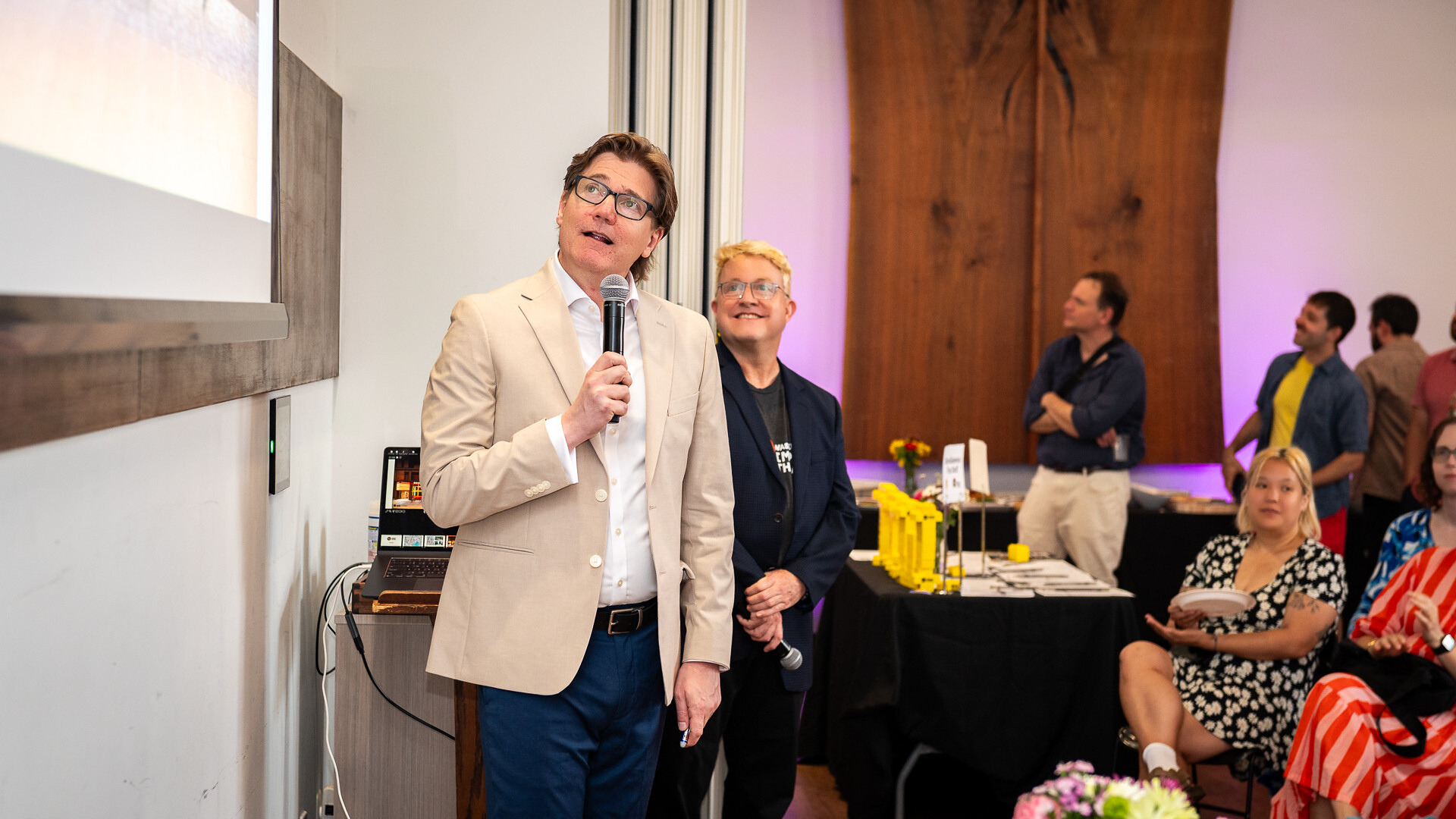
This is probably a good place to also mention that I have had a great team helping me — Olivia Haynie is an architect, who worked with me on the renderings and generated the fly-thru video, and Kim Ortega, whom some folks may have met at the Gala last year, is an interior designer who has been instrumental in many of the finish selections … in particular, the chairs for the theater (a very important thing)!
WIT: Are there ways in which improv informs your practice as an architect?
Matt: Absolutely! I embrace it fully! I proudly list it on LinkedIn. Beyond the ‘soft skills’ that it has greatly helped me with, it has also led to other opportunities to share my knowledge as a performer with people in the architecture community. This past fall, I had the thrill of teaching a five-week improv course for architecture students at Virginia Tech that was a ton of fun and useful. I used a lot of the skills and exercises we develop as improvisers to help students better communicate, improve their presentation skills, and boost their confidence. It was another opportunity to combine my passion for design and improv with my love for teaching and helping people.
WIT: Last, what excites you most about this project?
Matt: So many things! As an architect, this is such a fun and interesting project… performance spaces and public spaces like this, especially creative arenas, give me the freedom to provide playful and creative solutions. It’s really a dream as a designer to have the direction to make a space that people can enjoy. But, I have to say, what excites me the most is seeing how excited my friends and other people in the community are about this space and how much it means to so many of us for WIT to have a home of its own. I can’t wait to see the first time someone posts a pic to social media of themselves in front of the theater marquee, excited that they are performing that night… maybe for the first time! To design the backdrop to a lot of great future memories is truly an honor, and that I got the chance to help make that happen for people is really a wonderful reward.
Top photo: Matt Alexander poses in a hard hat bearing WIT’s logo and that of his architectural firm DMArchitects at the WIT’s Big Move fundraiser in June 2025. By Jeff Salmore