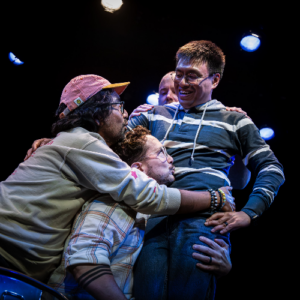
Punk Factory: A last-minute team turned FIST Comeback Brawler
One of the last teams standing in FIST 2026 came together in an unlikely fashion. Punk Factory, made up of Mikko Abarcar, Erick Acuña, John Paul Snead, and Travis West, were complete strangers before the tournament but wound up making it all the way to the Comeback Brawl, competing for a spot in the finals (that ultimately went to Your Favorite Exes).
Acuña is a familiar face at WIT as a member of the FIST-winning team and WIT ensemble The Broken Bones. Shortly before the FIST team sign-up deadline, Acuña emailed WIT headquarters and asked if there were any students still seeking a team. He was specifically interested in performing with new students with little prior experience.
While the deadline to be matched up via the FIST Matchmaker had passed, Acuña and WIT External Relations Director Dan Miller swiftly devised a plan email students in levels one through three with the opportunity to perform with an unnamed former FIST champion. Within twelve minutes of the email being sent, all three spots on the team had been claimed.
WIT talked to the team about their unusual beginning and their whirlwind through FIST 2026.
Erick: What spawned your initial query to WIT, asking to be matched up with students for FIST? As a longtime competitor and former champion, what was your approach to the competition?
EA: Thankfully, over the past decade in DC, I’ve been teaching and performing a lot (shout-out to my team The Broken Bones), and lately I’ve been more intentional about starting new comedy projects that show improv is for everyone and help build community.
So in 2025 I started a show called Acuña and Friends, where I do a monoscene with someone from the audience who has never done improv before. Honestly it has been one of the highlights of my improv journey. So I wanted to do something in that spirit again. Play with people I had never played with before, and create something that felt community-driven.
That’s what led me to reach out to WIT and ask if they could send an email to students from Level 1 to 3 to see if anyone would be interested. From what I understand, JP, Travis, and Mikko were the first to respond, and that became the team.
Going into it, the expectation was very simple. Maybe we do one show, and we just create a fun experience for them. It was really about supporting newer students and helping them feel excited and connected with the DC improv community. And then it became something way bigger than I ever expected.
JP/Travis/Mikko: You are all current students and hadn’t signed up for FIST independently. When the email about the team came up, what prompted you to express interest?
TW: I had asked a few classmates from my level 2 class if they wanted to form a team but there wasn’t enough interest. When I saw that an instructor wanted to work with students, I thought it would be a good way to take the first step into performing outside of the showcases at the end of each level.
MA: Honestly, I had some major imposter syndrome and didn’t sign up at first! But when the email about an instructor-led team went out, I figured it was the perfect safety net to learn from a total pro.
JP: Same as Mikko! I was intimidated by the competition element. But when I saw an instructor wanted to put a team together, I thought it’d be another learning experience, why not? Then when we found out it was Erick? Over the moon. Have you seen Erick on stage? Pure fun.
All: What was your first meeting like? How did you figure out your name and style?
MA: It was a blast! We dove right into rehearsal and clicked instantly. Erick really sold us on the idea of playing characters who actually like each other, leaning into that ‘joyful’ vibe made everything feel so much more natural.
JP: Ask me for name suggestions, and I’ll come back with 20 random ideas, including “The Middle Urinal.” Thankfully we didn’t go with that one! In that first meeting, we just started playing. We quickly clicked, learned about each other’s style, and how we all show up in scenes. Erick steered us to press into the joy and positive vibes. I was so intimidated by group scenes and peas in a pod. I thought, “But how do you actually keep a scene moving if there’s no conflict?” Then in our first show, it clicked. We were silly, happy, together, and vibing.
EA: What stood out immediately was how excited they were. That energy carried into our first rehearsal. We met at my place, and honestly it was just really joyful. I do improv almost every day, but it’s usually teaching, coaching, or performing. I don’t get to just rehearse, so this felt different in the best way.
There was something really refreshing about how they approached improv. They weren’t in their heads. They were just playing, and jumping in. What felt more important was building something that felt joyful, where characters actually like each other, where there’s a lot of love on stage.
That became the core of how we played. And then in our first show, it just clicked. We naturally fell into this format where all four of us were in every scene. No tag outs, no structure, just all of us jumping in together the whole time. It wasn’t planned as a gimmick, it just happened organically, and it was so much fun.
The name came together pretty casually too. JP threw out a few ideas, and since I like punk music, we went with one of those. At first it didn’t mean much, but by the time we did our first show, we realized it actually fit. There was something very punk about what we were doing. No pre-existing team, no big concept, no polished system. Just four people coming together, very DIY. And that ended up being the whole identity of the team.
TW: Our first scene was a monoscene, which I had never done before. We also fell naturally into peas in a pod, which I had only done in class a few times. It was so much fun! We embraced each other’s ideas and it flowed so naturally. Our first rehearsal was just very joyful; scenes weren’t about conflict, but instead just heightening the hilarity of each scene.
All: How did it feel to keep advancing in the competition, seeing very experienced teams get eliminated at the same time?
MA: It was totally surreal! I only expected to be there for one round, so every time we advanced it was a huge shock. I was super nervous every week, but it was so cool to watch the other teams. Seeing everyone from fellow students to the pros really taught me a lot.
JP: Y’all. Wild. So many of these improvisers have had me rolling in my seat laughing when I watch their shows. Sharing “Break-a-legs” and “great show” with these crazy funny and kind humans was an absolute blast.
EA: I never really paid too much attention to the competitive side or the voting. That part always feels a bit unpredictable. For me, it was always about having fun with the team and creating something joyful on stage. But I will say, this is now the third year in a row I’ve made it to the comeback bracket and lost, so I’m over it lol.
TW: It was bizarre. I had thought we would have two rounds max. The other teams were so strong and funny; it felt surreal to be backstage talking with them because they had years of experience and I just had finished level 2. But everyone was so kind. Even though it was a competition, there wasn’t any competitiveness backstage. Everyone wanted everyone else to succeed.
All: What are you taking away from this experience?
MA: Take a chance on people you don’t know! This whole thing was a happy accident that turned into a great friendship. It’s just a perfect example of how improv can be so magical.
EA: Improv is for everybody. Anybody can play, anybody can connect. It really comes down to lowering your guard, being vulnerable, and playing with a lot of heart. Not overthinking it, not trying to be wacky or force something, but just genuinely liking the other characters on stage and enjoying them.
JP: Jump in, be silly, be kind, say yes, and the funny will follow.
TW: Like Mikko said, take a chance! I learned so much from this experience and feel so much more comfortable on stage. I saw more improv than I would have ever seen if I wasn’t competing and I learned as much just from watching other people as I did from performing. I’ve made great friendships and met so many other talented improvisers.
All: What have you learned about yourself or the world through practicing improv?
MA: I’ve learned to trust my gut and the process. My brain throws a million ideas at me during a show, but I’ve realized I just need to pick one and commit to it. It’s so much more fun to be surprised by how a scene unfolds with the team. I’m carrying that into the real world now. It has helped me stop worrying about finding the ‘right’ path and just trust that I’ll find my footing whenever things shift.
JP: People can be so darn good and kind and funny. Find those people; they’re your people.
EA: I’ve been doing this for over a decade now, and I still love it every single time. Whether I’m performing, teaching, or coaching, it just never gets old. Improv is a huge part of my life. It really feels like a family to me. And honestly, I get a little sentimental even thinking about it, because it truly changed my life for the better.
TW: Learning to trust your teammates was such a revelation. I knew that if I threw out an idea, they would back it up and that freed me up to take more risks on stage. I learned that improv really is for everyone and if you are willing to take a risk, your team will support you and you can have so much fun.